
Executive summary
Workforce decisions affect more than payroll. They influence delivery capacity, management time, recruitment effort, continuity, knowledge retention, and the ability to respond when demand changes. A sound comparison should evaluate the total operating model rather than compare salary figures alone.
No single delivery model is right for every function. Permanent employees, augmented specialists, outsourced processes, and hybrid teams serve different needs. The best choice depends on the work, the degree of internal ownership required, the stability of demand, and the organization’s ability to manage delivery.
1. Start with demand, not the staffing label
Classify the work before comparing models. Is the need ongoing or temporary? Does it require a specialist skill that is difficult to recruit? Is the workload predictable? Does the work involve decisions that must remain within the organization? Can the process be documented and measured?
These questions determine which models are worth evaluating.
2. Understand the total cost
A permanent role can involve salary, benefits, recruitment, onboarding, equipment, software, management, training, and the cost of unused capacity when demand falls. The exact categories vary by country, role and company policy.
Staff augmentation can add flexibility, but the business still needs internal direction, task assignment, quality review, and integration with its existing systems.
Business process outsourcing may shift responsibility for executing a defined workflow, but it still requires clear scope, governance, data access rules, quality measures, and exception handling.
Hybrid delivery can combine local ownership with distributed execution. Its value depends on effective handoffs, communication, documentation, and clear decision rights.
The correct comparison should include all relevant costs and the business consequences of delays, errors, rework, and unused capacity. Avoid applying a universal savings percentage to every role.
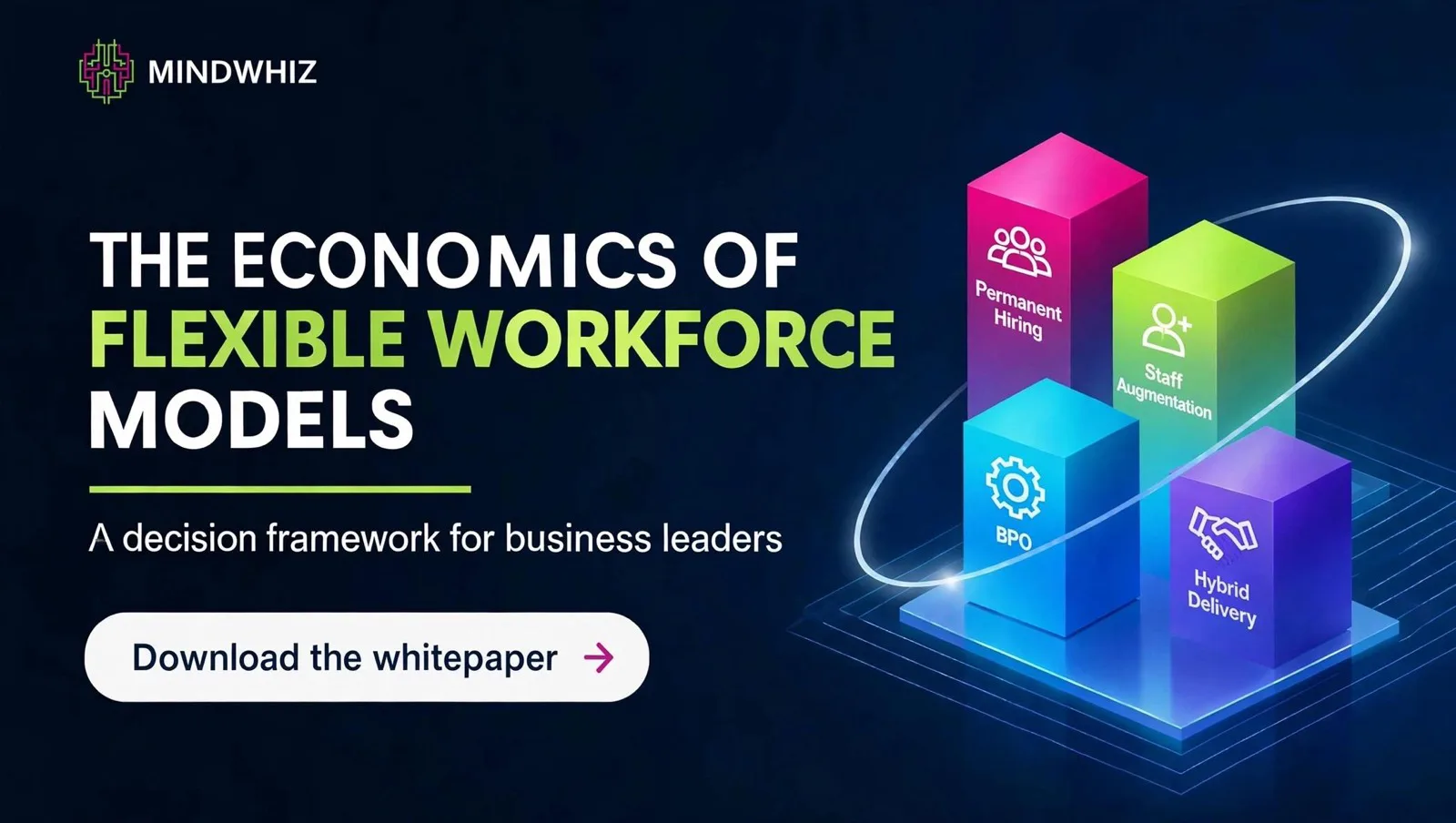
3. Compare the models
Permanent hiring
Best considered when the work is continuous, closely tied to institutional knowledge, and requires direct long term ownership. The tradeoff is that hiring and capacity adjustment may take time.
Staff augmentation
Best considered when a business needs additional expertise or capacity inside an existing team. Internal leaders retain direction and are responsible for integrating the additional professionals into their workflows.
Business process outsourcing
Best considered when a defined process can be governed through agreed inputs, outputs, service expectations, controls, and reporting. The business should retain ownership of outcomes and oversight.
Hybrid delivery
Best considered when the business needs close local collaboration for some responsibilities while other work can be completed by distributed teams. Success depends on explicit ownership and consistent communication.
4. Evaluate operational risk
Cost should never be the only decision factor. Assess access to sensitive information, business continuity, quality assurance, regulatory obligations, dependence on individual contributors, documentation, and escalation procedures.
For every model, ask who owns the work, who reviews it, who can approve exceptions, and what happens when the normal process fails.
5. Build a decision scorecard
Rate each model against the following criteria using a scale appropriate to your organization:
- 1Fit with demand duration.
- 2Specialist skill availability.
- 3Required internal control.
- 4Speed to usable capacity.
- 5Management effort.
- 6Quality and service requirements.
- 7Continuity and knowledge retention.
- 8Data security and compliance.
- 9Cost visibility.
- 10Ability to scale up or down.
The weights should reflect business priorities. A regulated process may prioritize control and auditability over speed. A time limited project may prioritize access to specialist capacity.
6. Establish governance before launch
Define the scope of work, responsible owners, service levels, reporting cadence, access permissions, quality checks, and escalation routes. Agree on what success means before delivery begins.
Use a limited initial scope where appropriate, establish a baseline, and review performance before expanding.
Conclusion
Flexible workforce models are not simply a way to buy labor differently. They are operating choices that affect accountability, capacity, and the way work gets delivered.
The strongest decision is the one that matches the actual work, makes ownership clear, and measures outcomes. MindWhiz supports onshore, offshore and hybrid staffing, staff augmentation, and managed services across IT, finance, HR, construction estimation, and business operations.
The strongest workforce decision matches the work, makes ownership clear, and measures outcomes.